Thesis Studio
Academic | Spring 2026
Academic | Spring 2026
Location: Chennai, India
Software: Rhino, Adobe Illustrator, Photoshop
Dhideer Nagar, Chennai, India
Chennai’s relationship with water and with its poorest residents is structured by inequality; governance responses continue to treat informal settlements as problems to be relocated rather than communities to be supported. In Dhideer Nagar, Saidapet, a riverfront settlement of approximately 300 families, flood vulnerability, livelihood loss, and displacement are not inherent conditions but produced by the result of infrastructure exclusion, insecure tenure, and policies that sever residents from the urban relationships they have spent decades building.
This thesis argues that resettlement, Chennai’s default response to informal riverfront settlements, compounds instead of resolving these vulnerabilities. Relocating communities to peripheral sites breaks the informal economic networks of domestic work, trade and labor that depend on proximity to the city and to one another. The research asks how these compounding conditions of flood vulnerability, threat to livelihood, and displacement can be addressed while protecting the social and economic fabric that residents have collectively built
The research proposes a phased, state-facilitated framework in which housing, infrastructure, and ground-level spaces are reorganized as incrementally produced, resident-owned resources. This takes the spatial form of cluster-based incremental housing in which families own and can expand over time, a holding house functioning both as a temporary rehousing structure during remodel cycles and a permanent civic space for daily life, and a phased blue-green riparian edge that transitions the settlement from ecological hazard to ecological participant along the river. The system of commoning is tested through design research at multiple scales, from the individual plot to the neighborhood. Using Dhideer Nagar as a projective site, this thesis advances not a singular solution but a transferable framework, arguing that in-situ redevelopment organized around commoning principles can produce ecological resilience, livelihood continuity, and spatial dignity without displacement, and that this logic is replicable wherever informal communities face dispossession in the name of urban development.
Dhideer Nagar, Saidapet
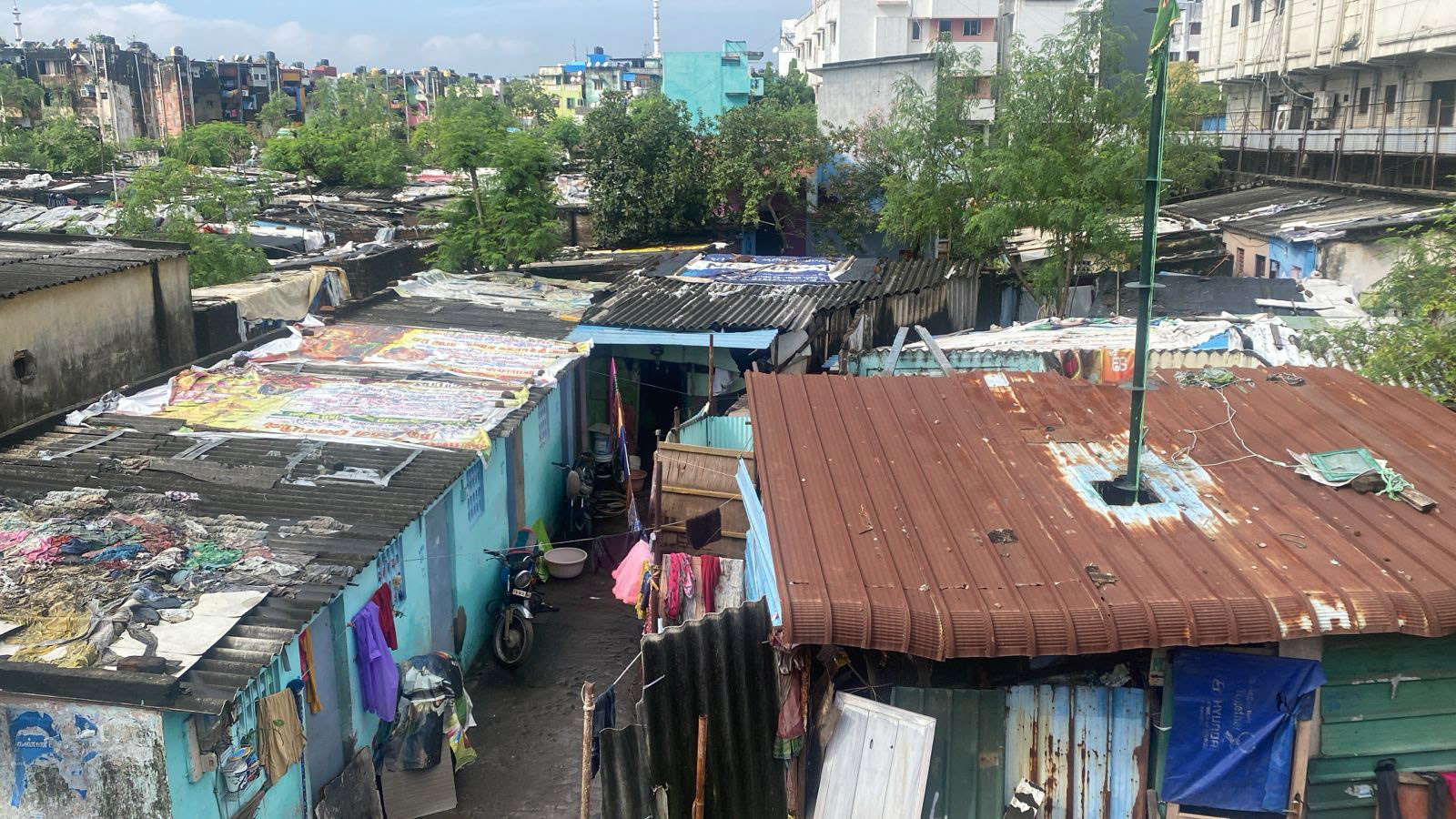
Dhideer Nagar is an informal riverfront settlement located along the Adyar River in Chennai. Positioned within a low-lying flood-prone zone, the settlement experiences recurring seasonal inundation during the monsoon, making it increasingly vulnerable to both environmental risk and redevelopment pressures. Like many informal settlements in Chennai, the site exists within a condition of insecure tenure, limited infrastructure, and inadequate access to formalized public services, while simultaneously remaining deeply integrated within the city’s labor and economic networks.
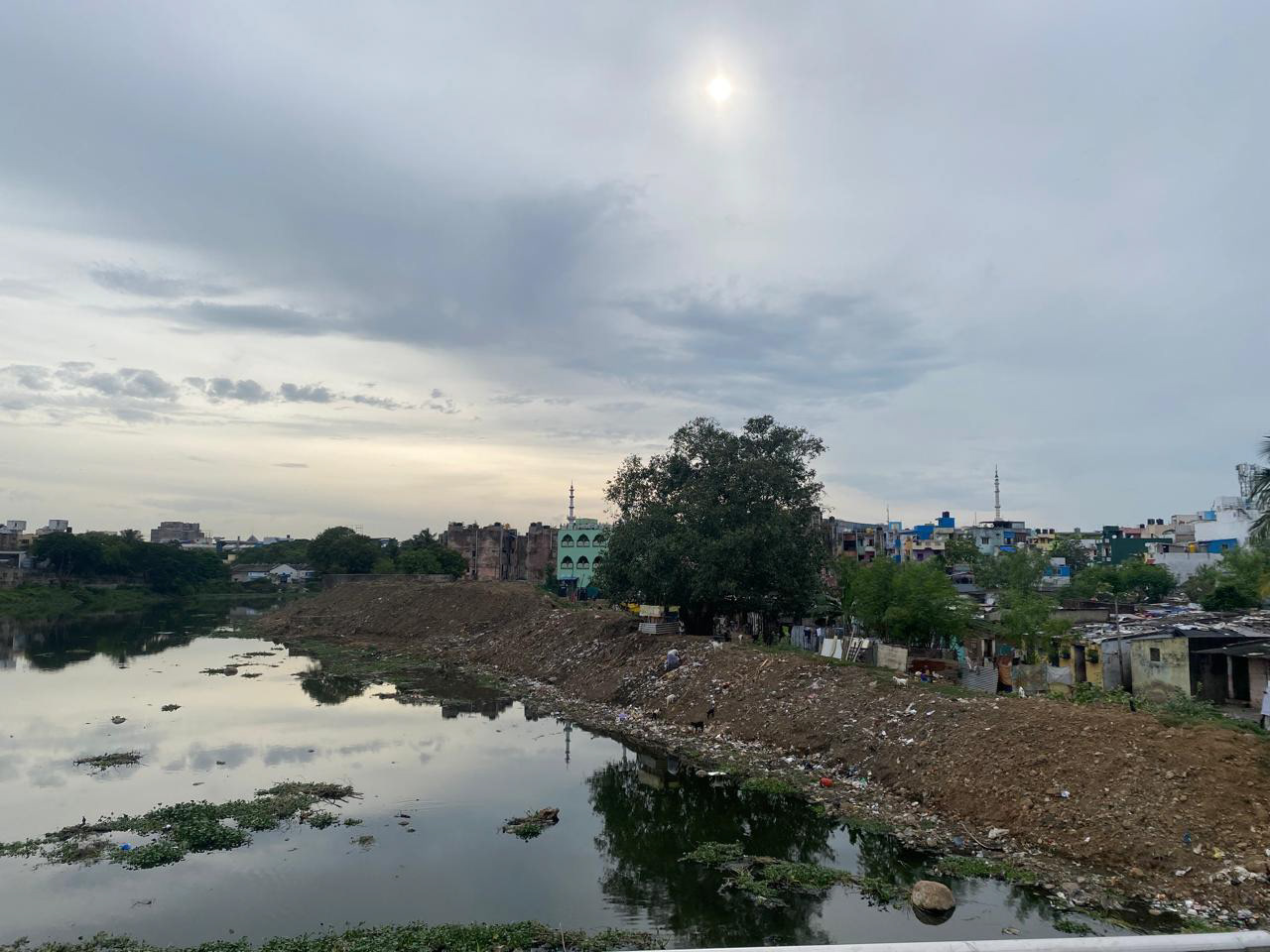
In this project, Dhideer Nagar serves as a projective site, a specific place through which a broader condition is examined and a replicable framework is tested. It is not treated as an isolated case requiring a singular solution, but as representative of the pressures facing informal riverfront communities across Chennai and beyond. The proposal developed here is not a prescription for Dhideer Nagar alone but an argument directed at the state about how it might fundamentally rethink its approach to communities that face the same compounding conditions of flood vulnerability, insecure tenure, and displacement threat wherever rapid urbanization meets the urban poor.
MAPPING AND ANALYSIS
Urban milieu mapping
Actor-Network diagram
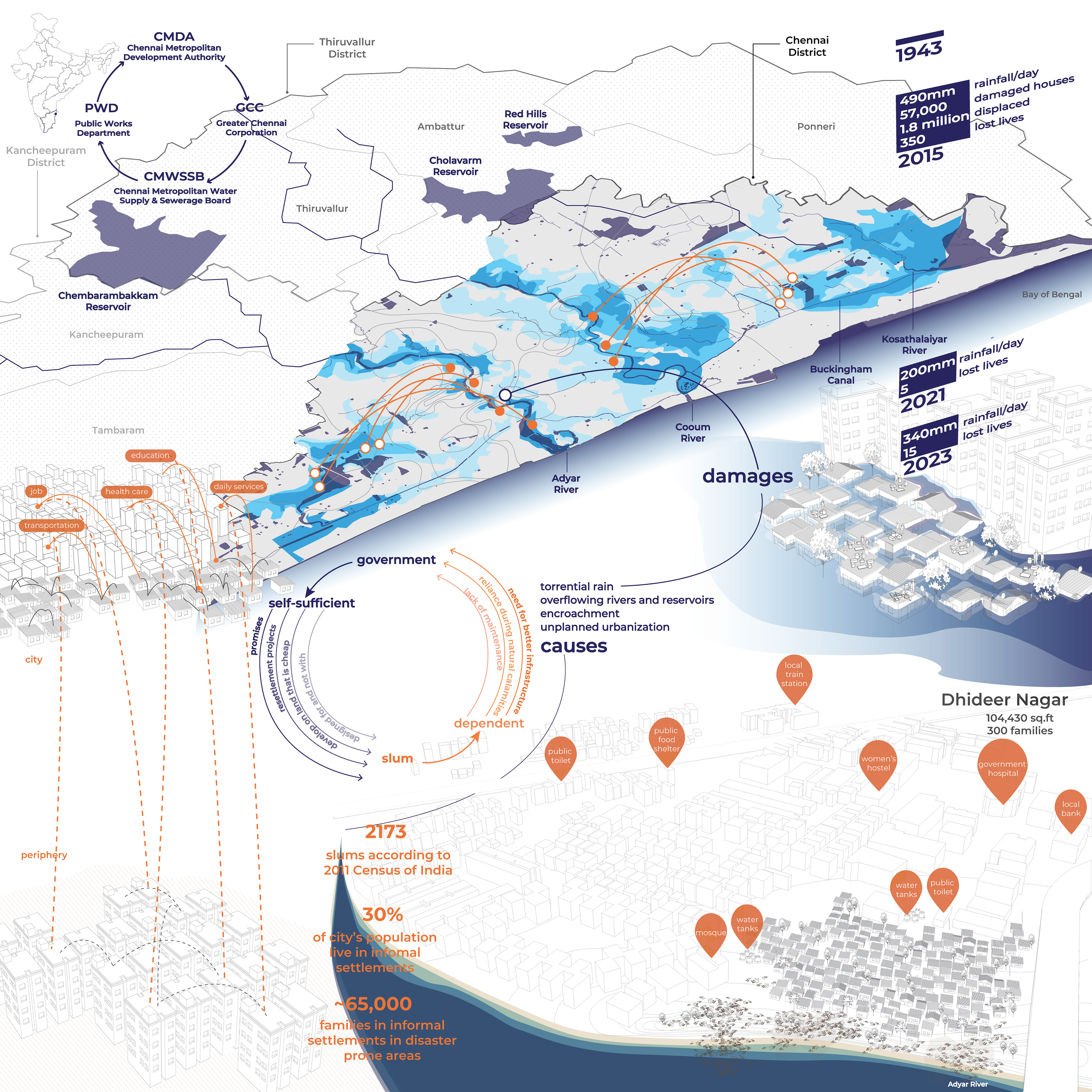
The urban milieu (image to the left) maps the larger systems, relationships, and conditions that shape the context of this research within Chennai. Rather than understanding flooding as an isolated environmental event, the mapping positions the city within a broader network of ecological vulnerability, governance fragmentation, infrastructural inequality, and uneven urban development. The mapping also examines the fragmented nature of governance surrounding land, water, housing, and disaster management within the city. Multiple institutions operate independently across overlapping jurisdictions, often producing disconnected or reactive responses to flooding and housing vulnerability. Within this condition, informal settlements located along waterways are frequently identified as sites of environmental risk and targeted for relocation through state-led resettlement schemes.
The urban milieu establishes the broader socio-spatial and ecological context within which the research operates, framing flooding, displacement, and housing insecurity not as isolated issues, but as interconnected urban conditions produced through the interaction of environmental systems, governance structures and decisions.
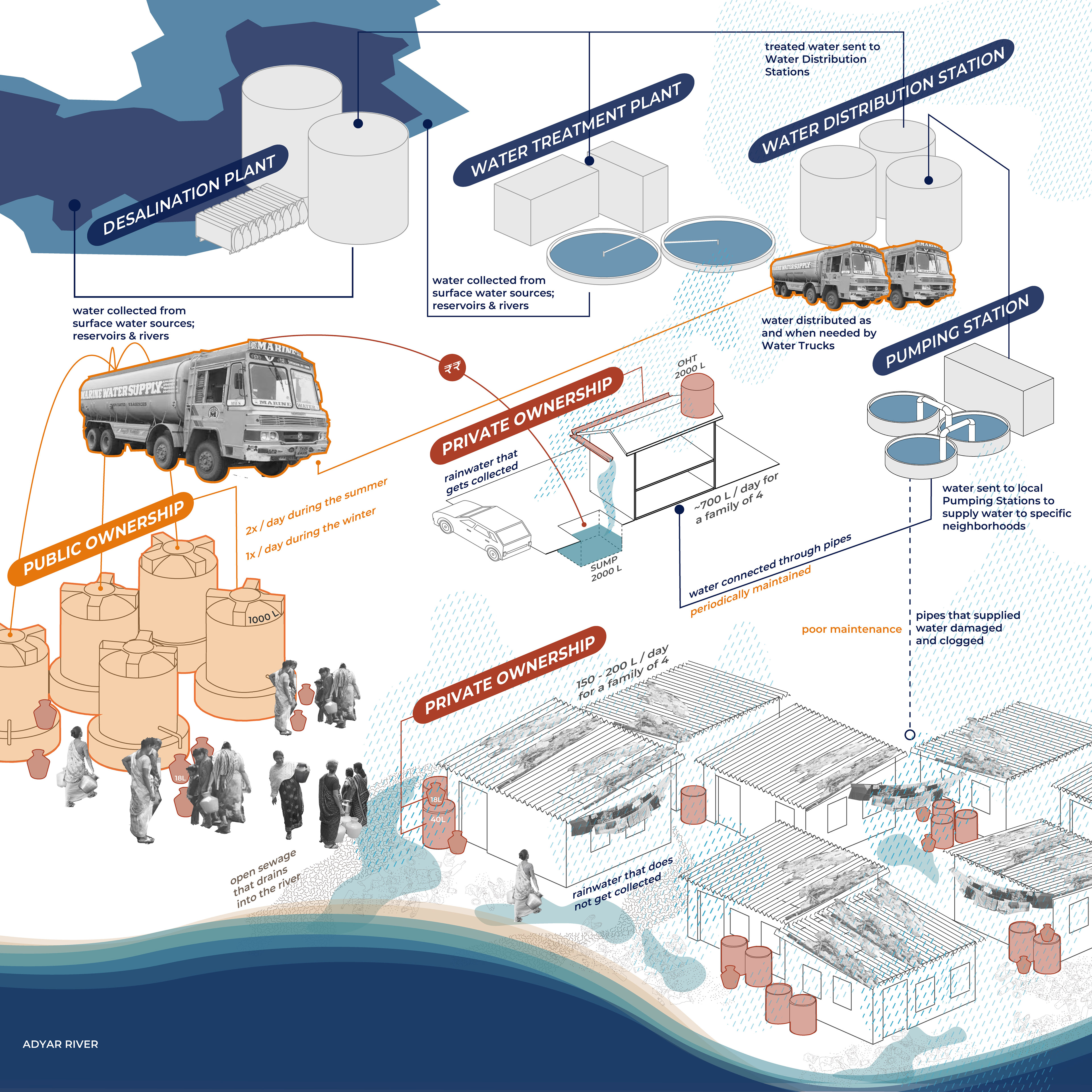
The actor-network (image to the right) maps the systems, actors, and infrastructures involved in the distribution, access, storage, and everyday use of water within Chennai, while comparing the unequal conditions through which water reaches formal and informal communities. Drawing from Actor-Network Theory, access to water is not a singular infrastructural system, but a network of relationships between human and non-human actors, including state agencies, pipelines, groundwater systems, flood cycles, storage infrastructure, informal practices, and resident communities. The network traces how water moves through centralized systems of extraction, treatment, and distribution before reaching different urban populations under highly unequal conditions. In formal residential areas, water access is supported by stable municipal infrastructure, private storage systems and consistent service connections that collectively increase the capacity of households to store water over time. Infrastructure in these environments functions as a layered system that absorbs interruptions and stabilizes access.
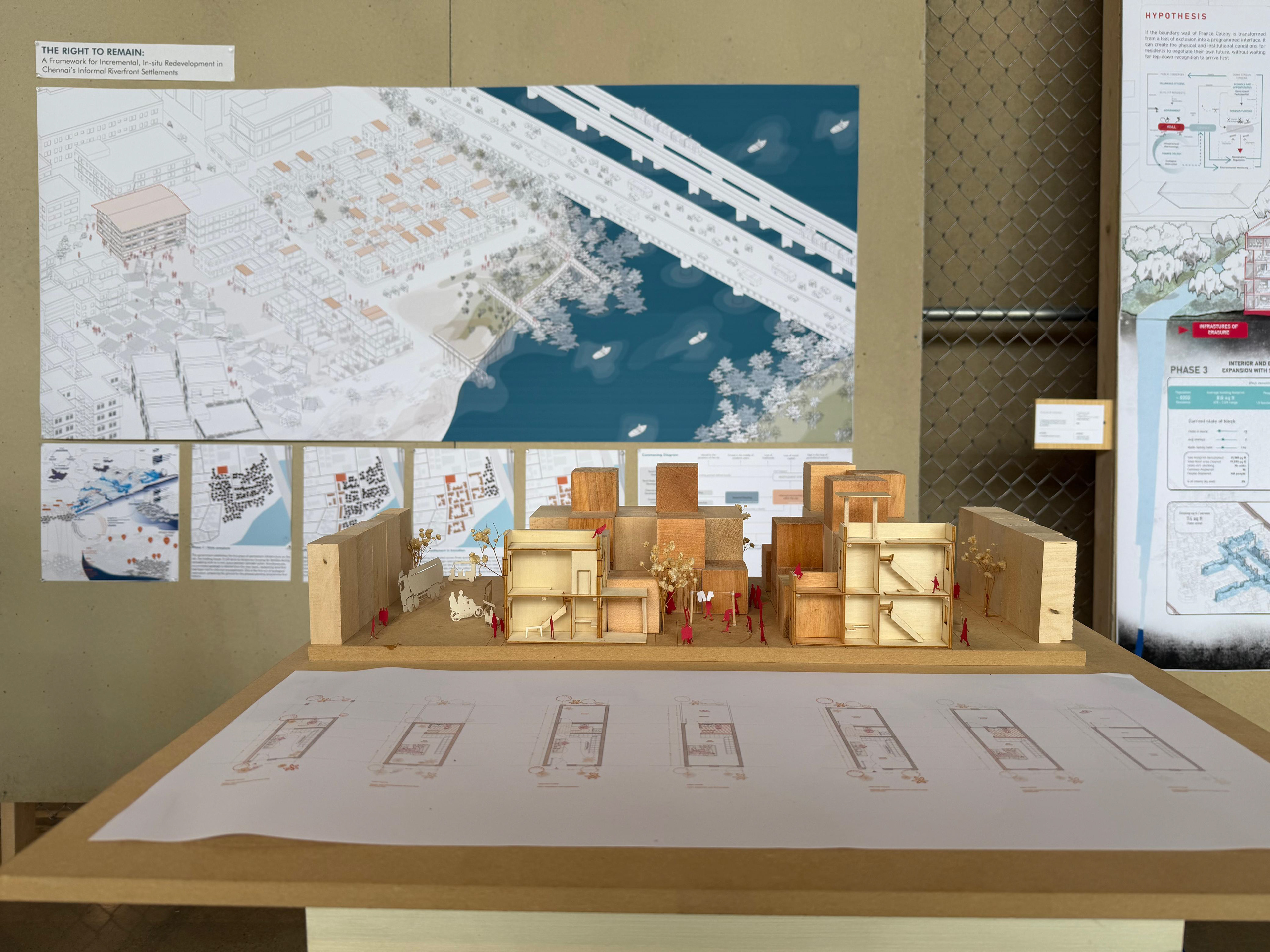
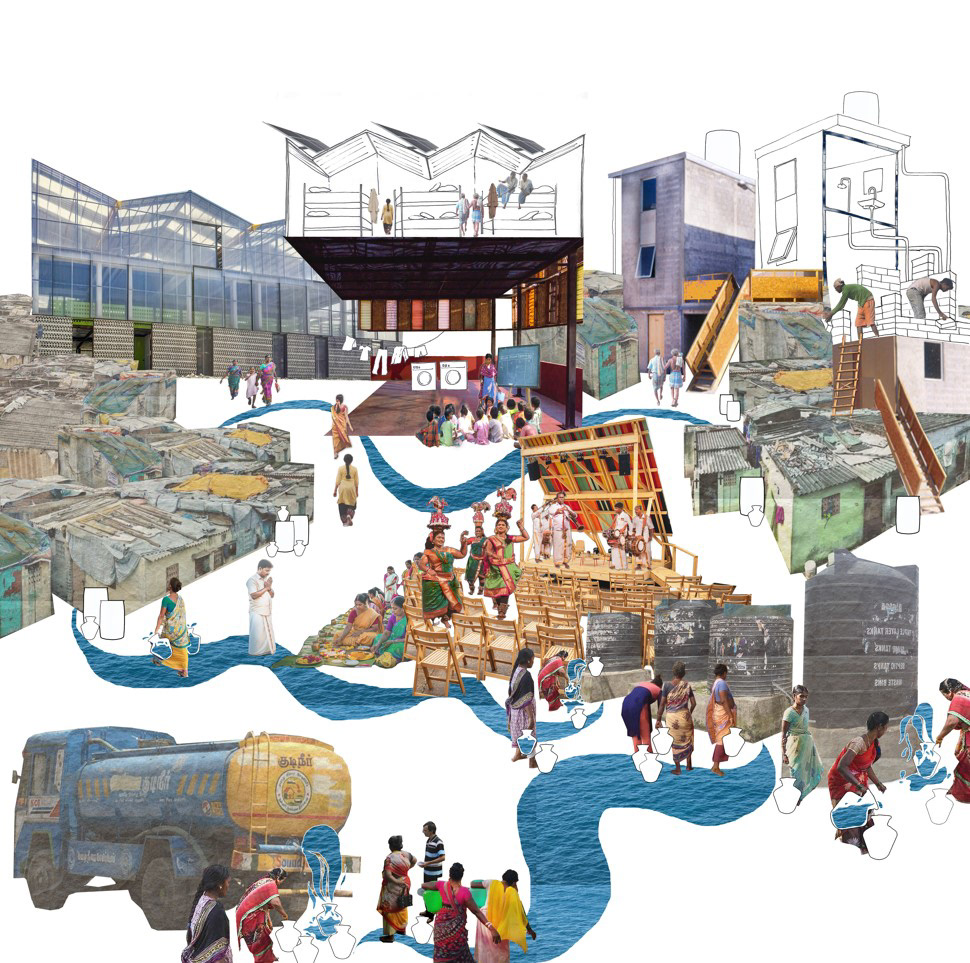
The Futuring Collage, inspired by Tatiana Bilbao's visualization, imagines Dhideer Nagar not as a settlement to be erased, but as a community capable of evolving through systems of collective support, shared ownership, and incremental growth. Rather than relying on relocation as the primary response to flood vulnerability, the proposal explores how in-situ redevelopment can strengthen the existing social and economic networks that already sustain everyday life within the settlement. The three commoning patterns that underpin the proposal, the holding house, incrementalism, and sweat equity, are legible in the collage as spatial outcomes. Through a phased process of redevelopment, residents can remain connected to their livelihoods, communities, and the city itself while gradually transitioning into safer and more resilient living conditions.
Research Question
How can the compounding conditions of flood vulnerability, livelihood precarity, and the recurring threat of displacement facing informal riverfront communities in Chennai be addressed without severing the social and economic networks that residents have spent decades building within the city?
Hypothesis
A phased, state-facilitated commoning framework - reorganizing housing, infrastructure, and active ground-level space as incrementally produced and resident-owned resources - can address flood vulnerability and livelihood precarity while preserving the social and economic fabric of informal riverfront communities, establishing Dhideer Nagar as a replicable model for in-situ redevelopment that builds resilience without displacement.
PROPOSAL
A Phased Commoning Framework for Dhideer Nagar
The proposal for Dhideer Nagar is a framework, a set of spatial, institutional, and ecological operations that work together over time to produce a resilient, self-determining community without displacement. It begins with the recognition that the settlement already contains the social and economic intelligence needed for its own development. What it lacks is not the will to build but the institutional support, the secure tenure, and the shared infrastructure that would allow that intelligence to operate.
The institution that makes the phased process viable is the holding house, informed by Teddy Cruz and Fonna Forman’s Casa Familiar in Tijuana. Constructed in the first phase on cleared land at the river edge, it provides temporary housing for displaced families during rolling remodel cycles while simultaneously functioning as a civic building: a skills training centre, community hall, and disaster refuge. The holding house is not temporary infrastructure, but a permanent civic investment.
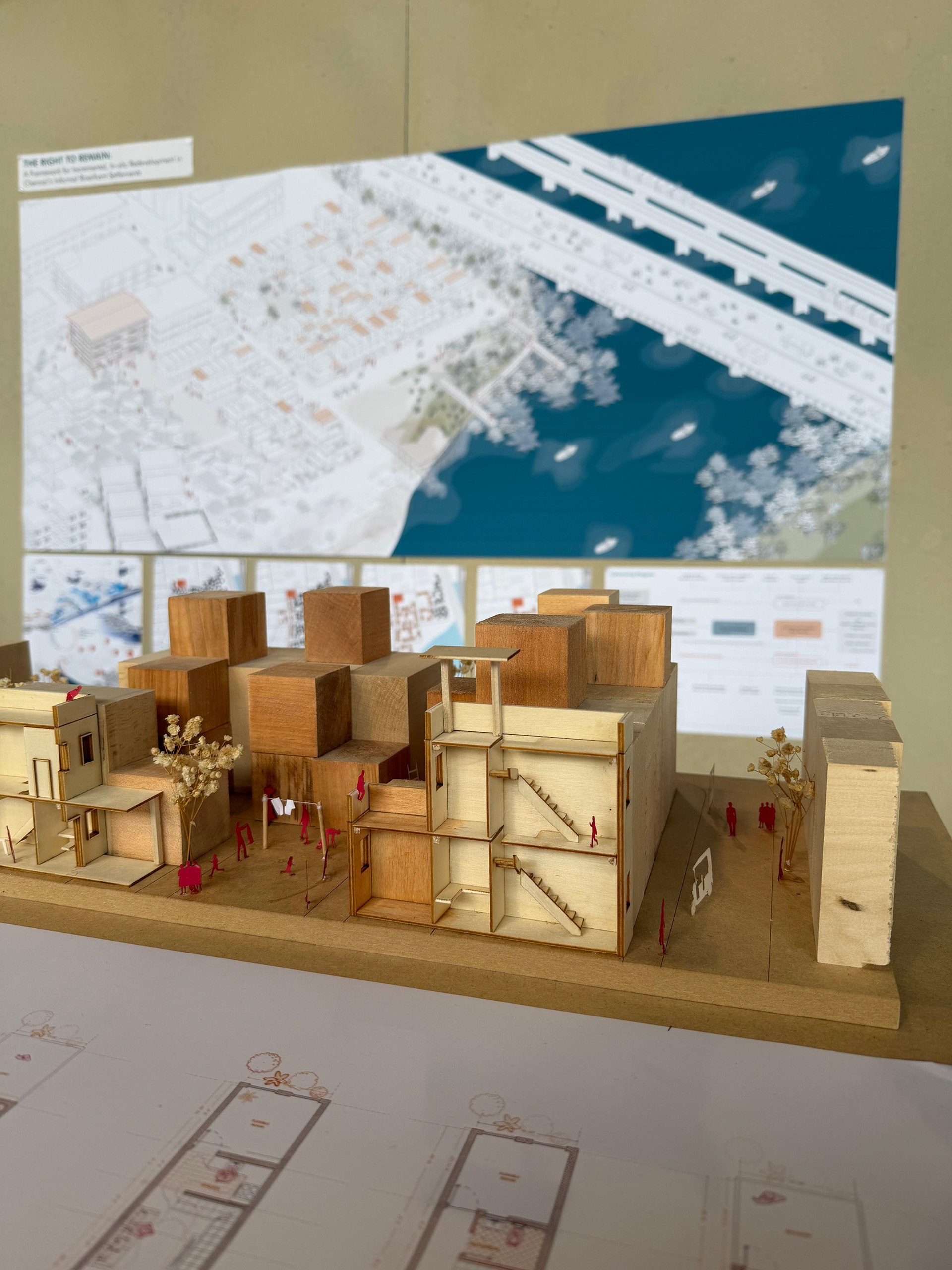
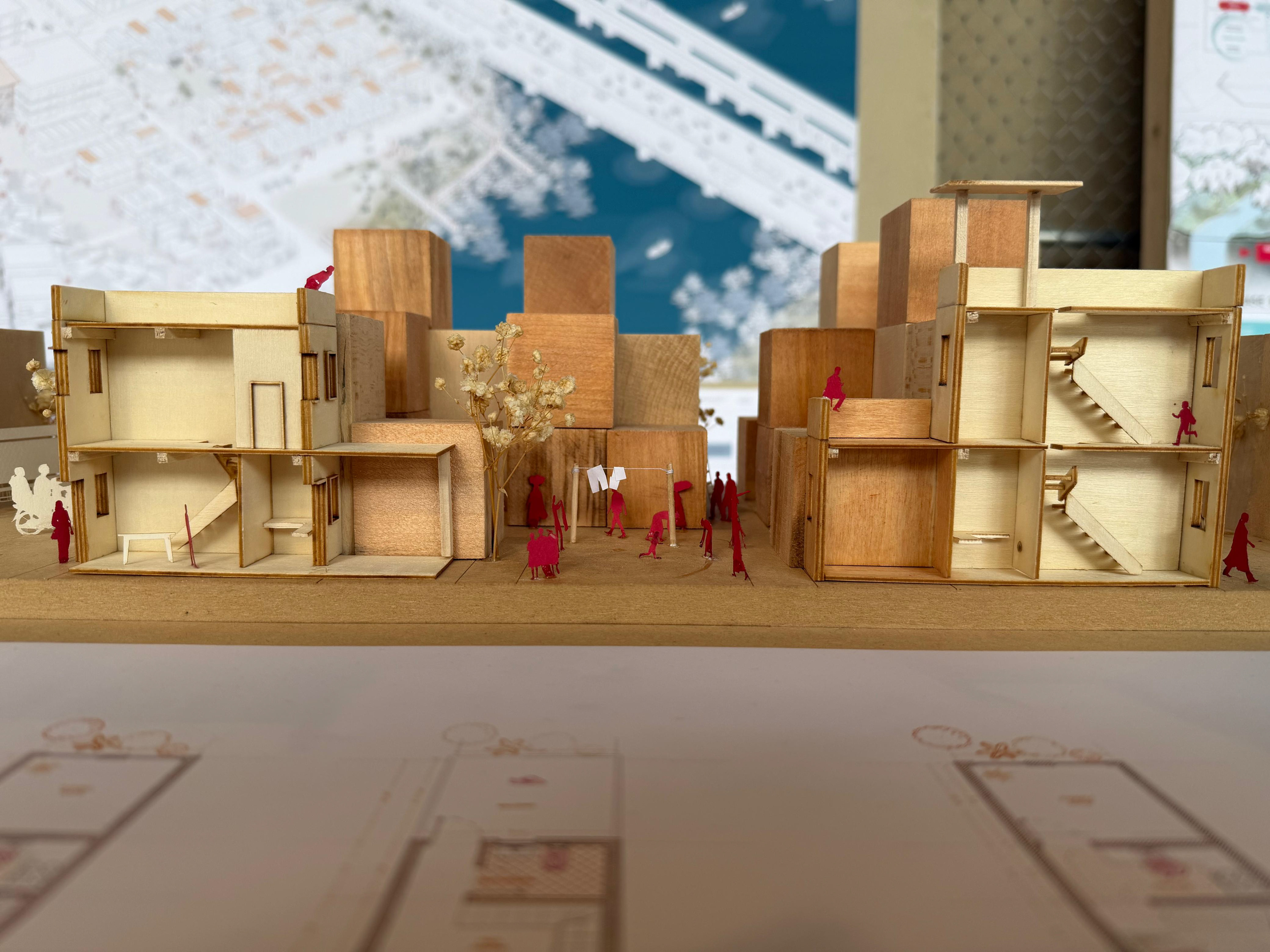
Drawing from Charles Correa’s Belapur housing project, specifically its organization of incremental growth around a hierarchy of shared courts, the proposal reorganizes the settlement fabric around a Belapur-derived spatial hierarchy. This hierarchy is not imposed, but emerges as a consequence of the remodelling sequence, becoming more legible at each phase as more clusters are rebuilt and oriented correctly. The incremental housing typology draws from Alejandro Aravena’s Elemental half house, the principle that the state should build the structural half that the family cannot build alone, and leave the rest to the family. Each household receives a 250-square-foot structurally complete unit on a 350-square-foot plot. The remaining 100 square feet is a designated growth zone toward the back lane, built by the family on their timeline, according to their need.
The result is not a uniform settlement but a varied neighborhood that reflects the genuine decisions of families building on their own terms, rooted in place rather than repeatedly displaced from it.
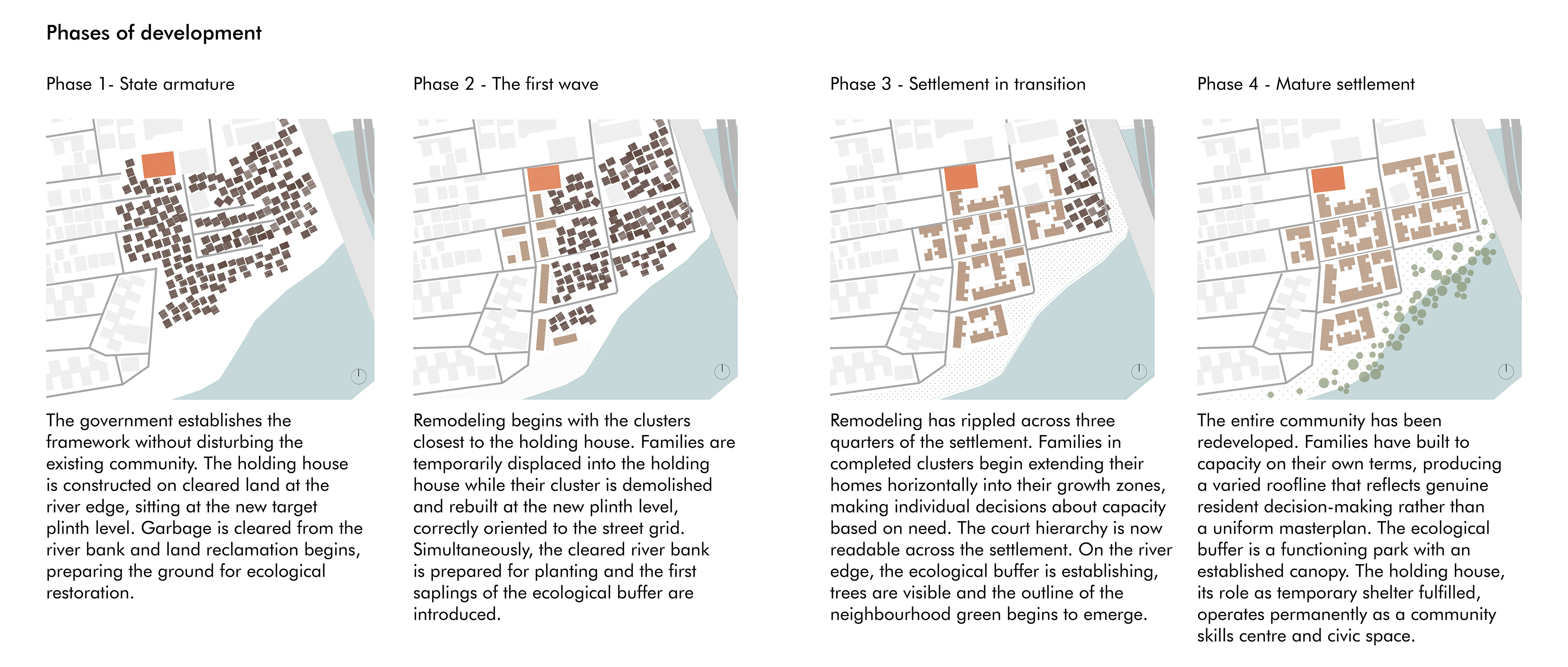
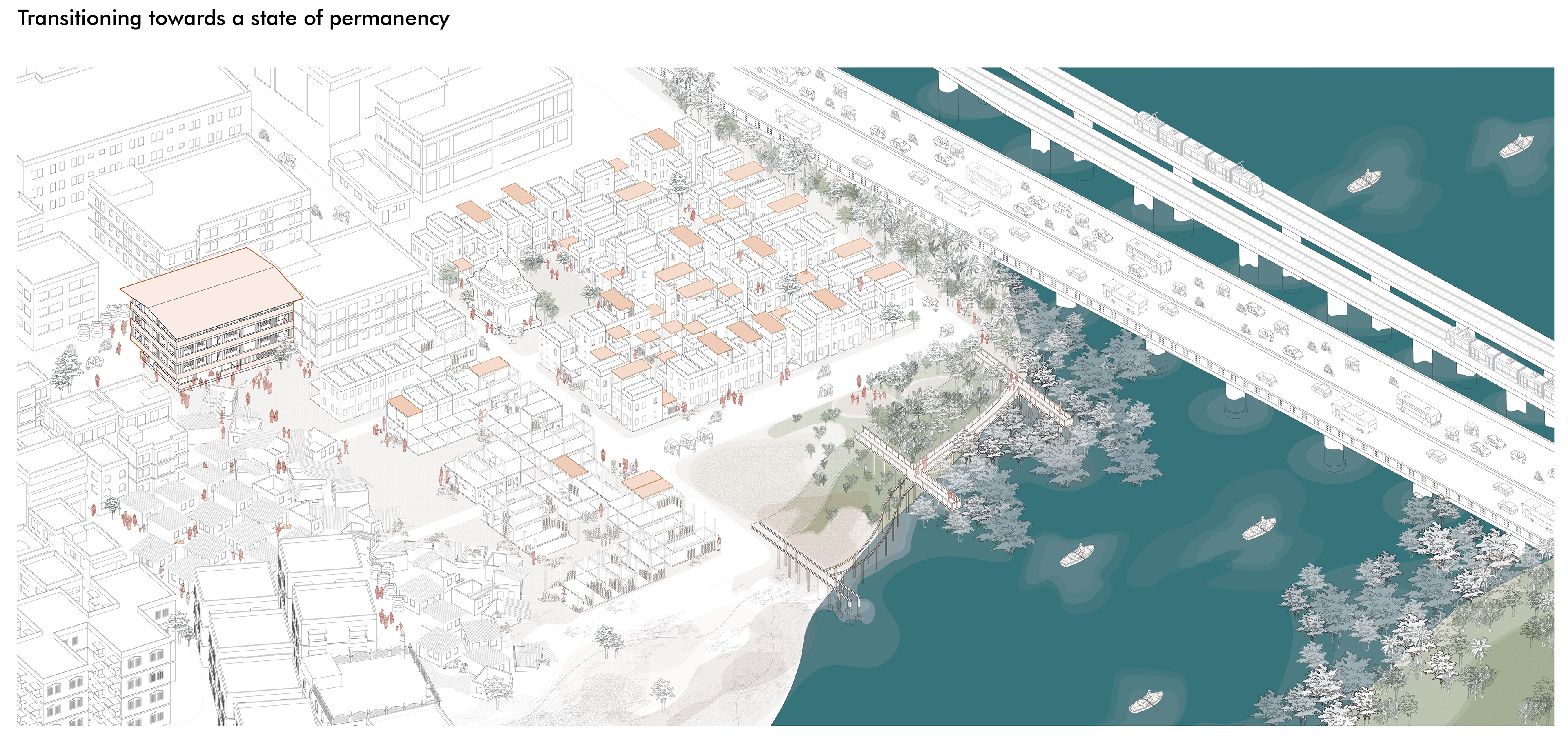
The drawing depicts the phased evolution of Dhideer Nagar, from an informally settled, flood-vulnerable riverfront to a resilient, resident-built neighborhood, ecologically integrated with the Adyar and organized around a hierarchy of shared spaces that the community has produced, owns, and continues to shape on its own terms.
Incremental housing
The housing unit is organized around a single 350 square foot plot. In its first iteration, the government provides and hands over a structurally complete unit of 250 square feet and the remaining 100 square feet of the plot is left as a designated growth zone toward the back lane, to be built by the family on their own terms and timeline.
In the first resident-led expansion, each family extends into this growth zone horizontally, adding a flexible room whose use is determined entirely by the family’s need at that moment. The roof of the ground floor extension becomes a transitional terrace for the first floor.
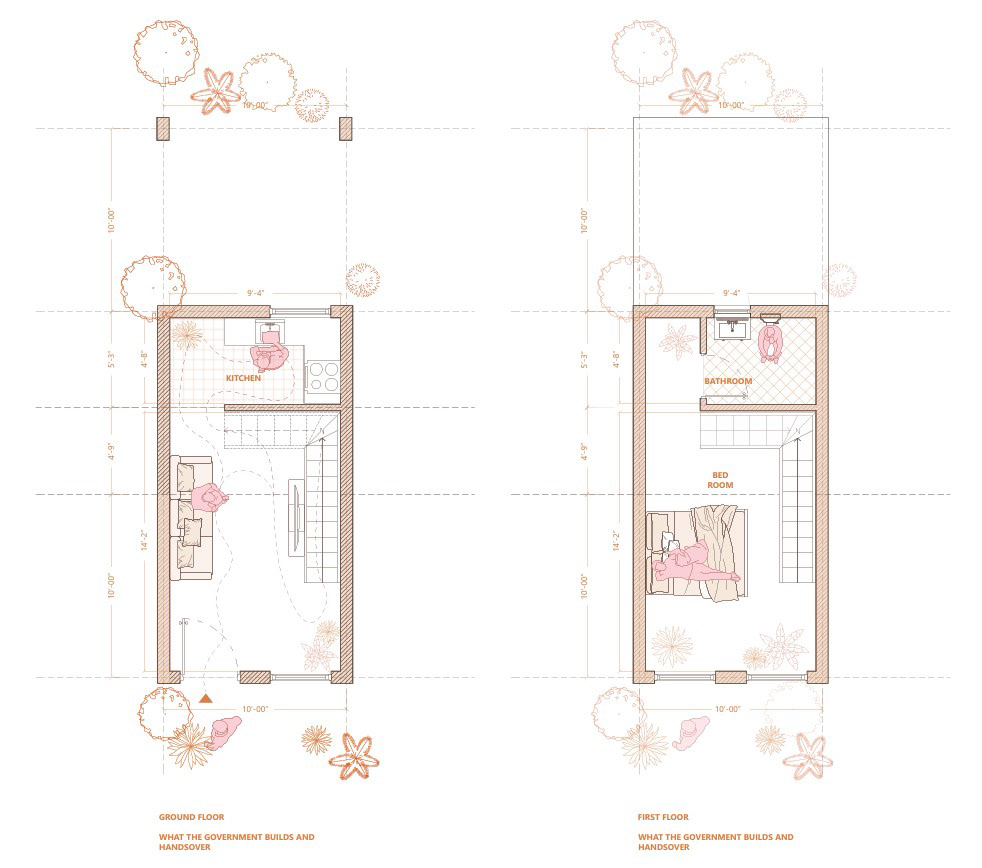
Phase 1 - State-led development
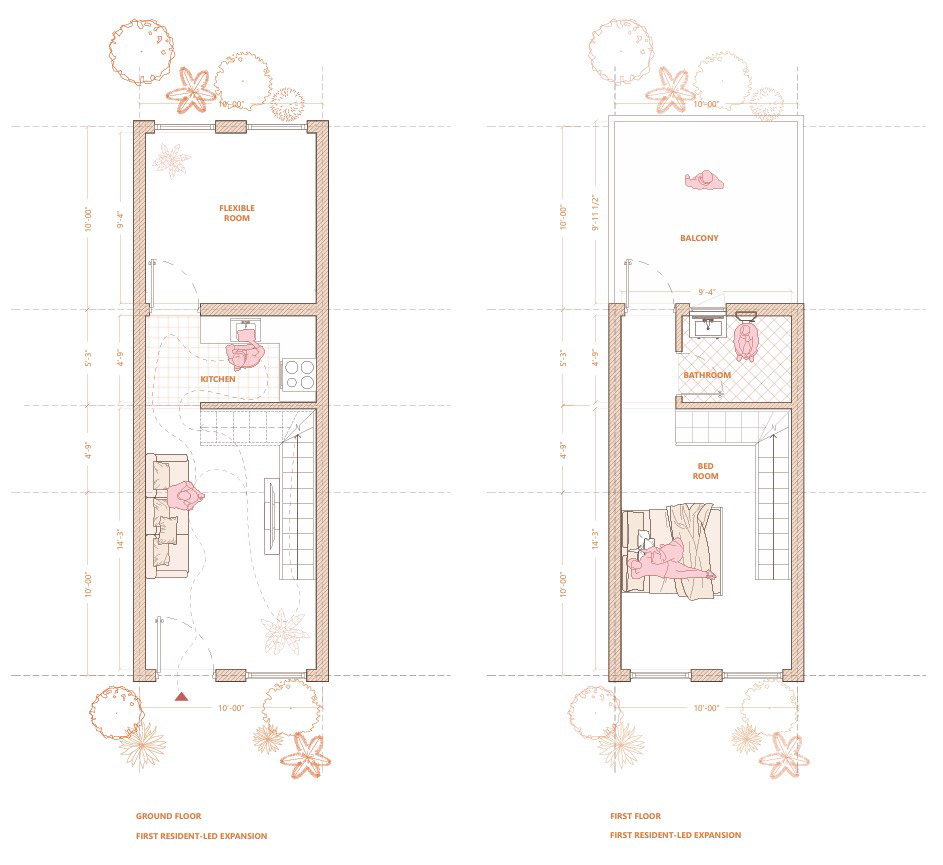
Phase 2 - First resident-led expansion
In the second expansion, both floors are fully built out to the plot boundary and a third floor is added, with the roof of the first floor extension now functioning as a balcony. At each stage the court-facing front of the unit remains as the social face of the house that activates the shared cluster court. All growth happens towards the back, leaving the ground plane and the hierarchy of shared space permanently intact.
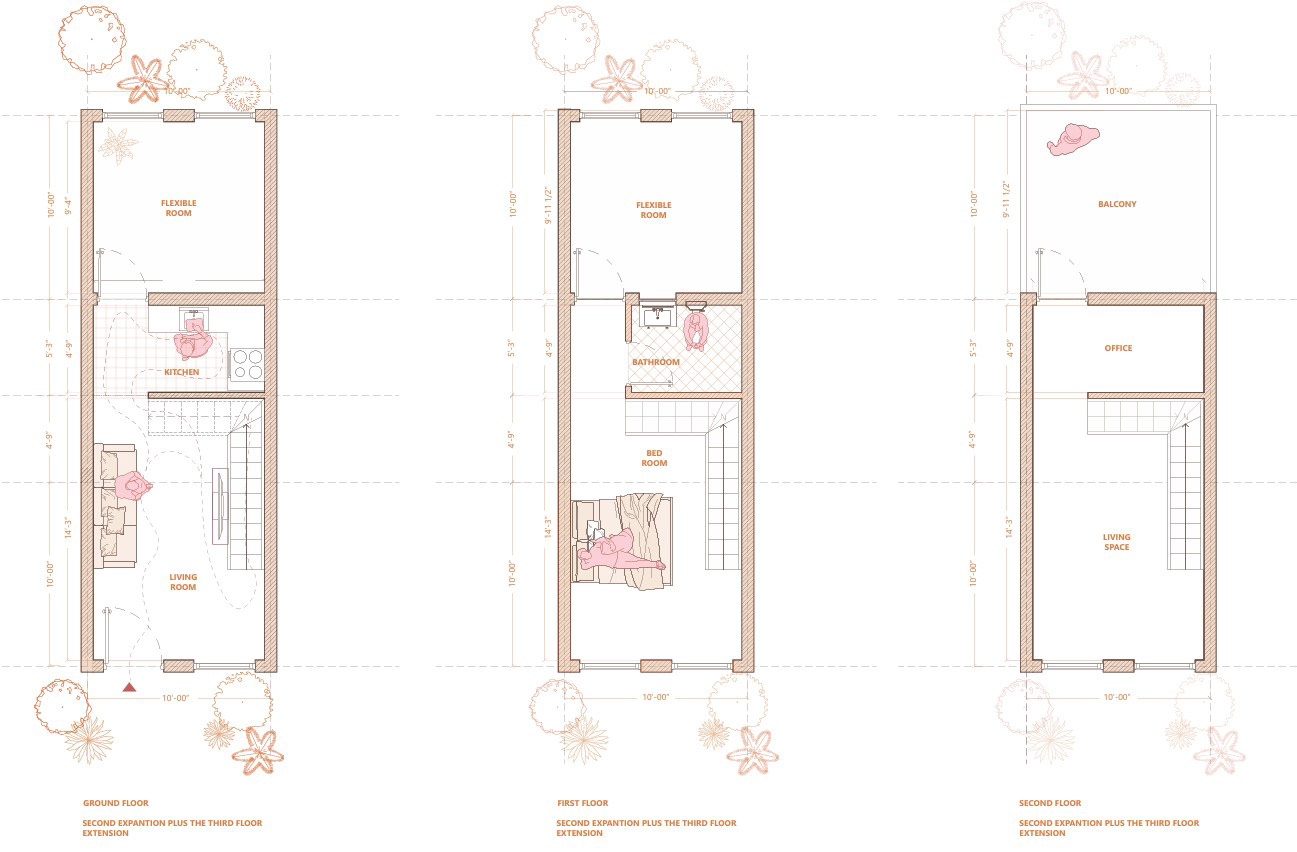
Phase 3 : Complete resident-led expansion
CONCLUSION
Towards a framework in practice
This thesis began with a question about displacement and ended with a proposal for its alternative. What has emerged is not a finished solution but a framework, one that argues, through spatial, ecological, and institutional means, that informal riverfront communities do not need to be moved to be made resilient. They need to be invested in, on their own terms, in place.
The proposal developed through Dhideer Nagar is speculative but grounded. Every spatial decision is informed by the specific conditions of the Adyar riverfront, the social and economic fabric of the settlement, and the precedents of practitioners who have navigated similar conditions elsewhere. It is a framework that takes seriously both the vulnerability of the community and its capacity, the decades of collective intelligence that informal settlements accumulate and that top-down redevelopment consistently destroys